Wet Scrubber System Manufacturers in India | Yansons Engineering


Yansons Engineering Pvt Ltd is a trusted Wet Scrubber System Manufacturers in India, Suppliers and Exporters in India, providing engineered air pollution control solutions for diverse industrial applications. We have more than 26 years of industrial experience in developing equipment for controlling air pollutants, industrial fumes, dust particles and process-generated gases.
Our Industrial Wet Scrubber solutions are designed according to the nature of pollutants, gas flow rate, operating temperature, chemical properties, pressure drop and required removal efficiency. We offer customized wet scrubbing solutions for steel plants, foundries, chemical industries, where effective emission control is essential.
With extensive industrial application experience, we provide Industrial Scrubber Systems designed to support cleaner production environments and effective air pollution management. Our range includes a Mild Steel (MS) Wet Scrubber System, Stainless Steel (SS) Wet Scrubber System, Fiberglass Reinforced Plastic (FRP) Wet Scrubber Systems and Polypropylene (PP) Wet Scrubber System. We focus on application-specific engineering, suitable material selection and reliable system integration to meet the requirements of different industries.
What Is a Wet Scrubber System?
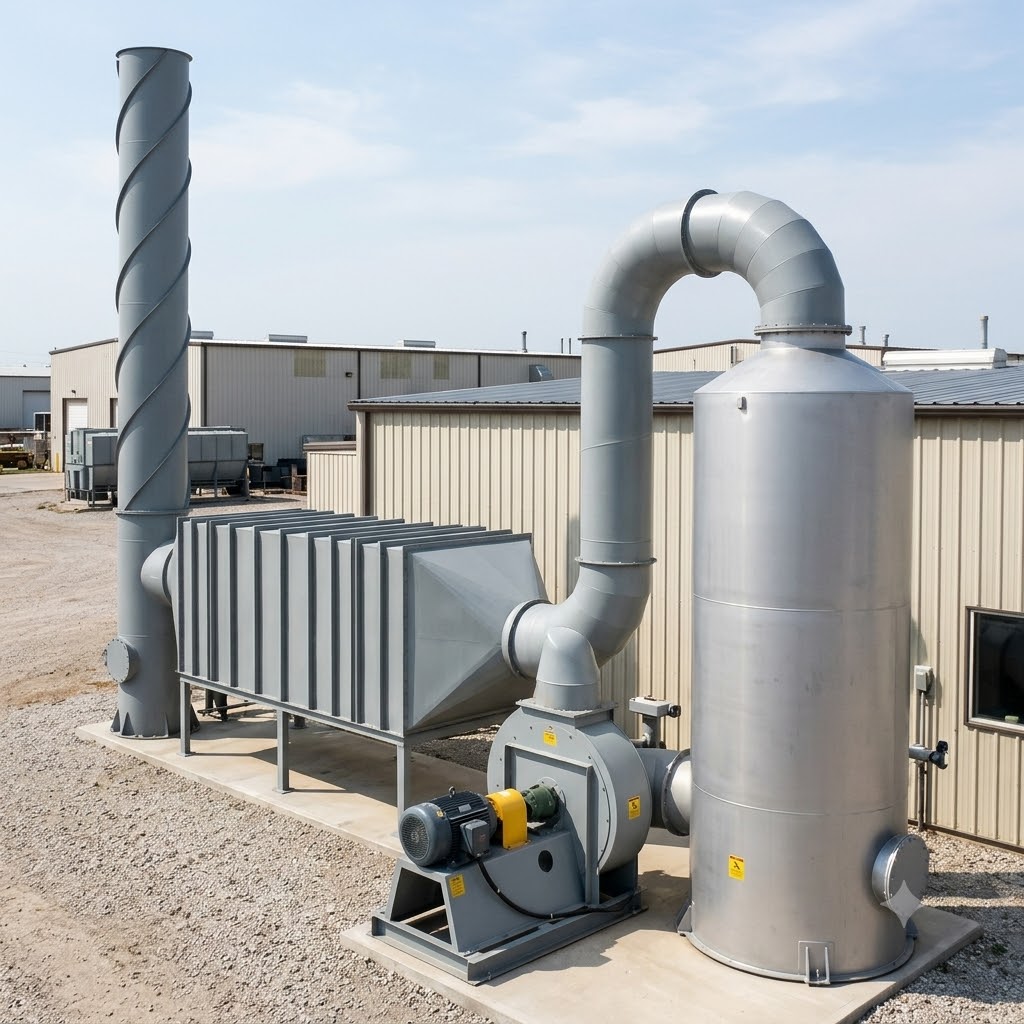
A Wet Scrubber System is an air pollution control device that uses a liquid, generally water or a suitable chemical solution, to remove dust particles, fumes and certain gaseous pollutants from industrial exhaust streams. The contaminated gas comes into contact with the scrubbing liquid, allowing targeted pollutants to be captured, absorbed or neutralized, depending on the system design and chemical process.
What Is the Purpose of an Industrial Wet Scrubber?
A properly designed Industrial Scrubber System can help industries:
- Control selected gaseous pollutants, fumes and airborne particulate matter.
- Reduce dust and contaminant levels in industrial exhaust streams.
- Reduce the release of targeted pollutants into the surrounding environment.
- Support applicable environmental compliance requirements when correctly designed, operated and maintained.
How Does Our Wet Scrubber System Work?
- Contaminated Gas Entry: Industrial exhaust containing dust, fumes or targeted gaseous pollutants enters the scrubber through an inlet duct connected to the process or exhaust source.
- Gas-Liquid Contact: Water or a suitable scrubbing solution is introduced through spray nozzles or a liquid distribution arrangement to create contact between the contaminated gas and the liquid.
- Pollutant Removal: Dust particles can be captured by liquid droplets, while suitable gaseous pollutants may dissolve into the liquid or react with the scrubbing chemicals. The removal mechanism depends on the pollutant and the selected technology.
- Mist Separation: A mist eliminator or suitable separation arrangement removes entrained liquid droplets from the treated gas before it leaves the system.
- Treated Gas Discharge: The treated gas exits through the outlet duct and may be discharged through a stack according to the installation and applicable emission requirements.
- Liquid Collection and Management: The used scrubbing liquid is collected for recirculation, treatment or disposal, depending on the process design and the contaminants present.
What Are the Different Types of Wet Scrubber Systems We Provide?
As experienced Wet Scrubber System Manufacturers in India, we offer material options and configurations selected according to the process environment, pollutant characteristics, chemical compatibility and operating conditions.
- Mild Steel (MS) Wet Scrubber System: It can be considered for dust control, selected exhaust treatment processes and general industrial air pollution control. The internal coating, lining or corrosion protection requirements should be evaluated according to moisture levels, chemical exposure and operating conditions.
- Stainless Steel (SS) Wet Scrubber System: It is designed for applications requiring suitable corrosion resistance, durability and hygienic or cleanable construction. Stainless steel grades are selected according to the chemicals involved, chloride concentration, temperature and other process conditions. These systems can be considered for chemical processing, food-related manufacturing and specialized industrial exhaust applications where the selected grade is compatible with the scrubbing environment.
- Fiberglass Reinforced Plastic (FRP) Wet Scrubber Systems: FRP construction can offer a suitable combination of corrosion resistance and relatively low weight when the resin system and structural design match the process conditions. These systems are commonly considered for chemical plants, fertilizer facilities, metal treatment operations and other corrosive exhaust environments.
- Polypropylene (PP) Wet Scrubber System: It can be considered for acidic or alkaline gas treatment and industrial fumes, subject to the specific chemical concentration and operating temperature. PP scrubbers are selected according to chemical resistance, mechanical requirements and installation conditions.
- Industrial Wet Scrubber: An Industrial Wet Scrubber is designed to treat exhaust streams generated by industrial processes. Depending on the application, it can use spray towers, packed-bed arrangements or other suitable gas-liquid contact technologies. The system is selected according to gas flow, pollutant type, inlet concentration, temperature and required removal performance.
- Industrial Scrubber System: control arrangement that can include a scrubber vessel, circulation pump, liquid tank, spray nozzles, mist eliminator, ducting, exhaust fan, chemical dosing equipment and control instrumentation. The system can be configured for a single process or integrated with multiple exhaust collection points when supported by the required engineering design.
Technical Specifications of an Industrial Wet Scrubber System
As Wet Scrubber System Suppliers in India, we recommend selecting specifications according to the actual process conditions rather than relying on one standard configuration. The following table provides the main parameters to evaluate when selecting a system.
| Technical Parameter | Mild Steel (MS) Wet Scrubber | Stainless Steel (SS) Wet Scrubber | FRP Wet Scrubber | Polypropylene (PP) Wet Scrubber |
|---|---|---|---|---|
| Construction Material | Mild steel, 3–10 mm plate thickness | SS 304 / SS 316, 2–8 mm thickness | FRP laminate, 4–12 mm thickness | PP sheets, 5–15 mm thickness |
| Gas Flow Capacity | 1,000–100,000 m³/h | 500–80,000 m³/h | 500–60,000 m³/h | 500–40,000 m³/h |
| Pollutant Type | Dust, fumes and selected gases | Compatible dust, fumes and gases | Corrosive gases, fumes and particles | Compatible chemical fumes and gases |
| Operating Temperature | 50–200°C, subject to lining and design | 50–400°C, subject to grade and design | 20–120°C, subject to resin selection | 10–90°C, subject to PP grade and design |
| Scrubbing Liquid | 500–20,000 L/h | 300–15,000 L/h | 300–12,000 L/h | 200–8,000 L/h |
| Gas-Liquid Contact | Spray tower or packed bed | Spray tower or packed bed | Spray tower or packed bed | Spray tower or packed bed |
| Corrosion Protection | 1–5 mm protective lining, where required | SS 304 / SS 316 grade selection | 4–12 mm FRP laminate with suitable resin | 5–15 mm PP sheet, based on chemical compatibility |
| Installation Type | Floor-mounted or customized | Floor-mounted or customized | Floor-mounted or customized | Floor-mounted or customized |
| System Integration | Fan, ducts, pump and liquid handling | Fan, ducts, pump and liquid handling | Fan, ducts, pump and liquid handling | Fan, ducts, pump and liquid handling |
| Typical Pressure Drop | 500–2,000 Pa | 500–2,500 Pa | 500–2,500 Pa | 500–2,000 Pa |
| Typical Removal Efficiency | 70–99%, depending on pollutant | 70–99%, depending on pollutant | 70–99%, depending on pollutant | 70–99%, depending on pollutant |
Advanced Features of Our Industrial Wet Scrubber System
As Industrial Scrubber System Manufacturers, we focus on practical design features that support suitable pollutant removal and dependable operation.
- Application-Specific Engineering: Each wet scrubber can be designed according to the gas flow rate, pollutant concentration, temperature, chemical composition and available installation space.
- Suitable Material Selection: MS, SS, FRP and PP construction options can be evaluated according to corrosion risk, chemical compatibility, mechanical strength and process requirements.
- Efficient Gas-Liquid Contact: Appropriate spray arrangements, packing media or other contact mechanisms help improve interaction between the contaminated gas and scrubbing liquid.
- Integrated Mist Elimination: A suitable mist eliminator helps reduce liquid droplet carryover from the scrubber outlet, depending on the design and operating conditions.
- Liquid Circulation and Dosing: The system can incorporate liquid circulation pumps, storage tanks, dosing equipment and monitoring arrangements according to the required treatment process.
Where Are Our Wet Scrubber Systems Applicable?
As Wet Scrubber System Exporters in India, Our Industrial Wet Scrubber solutions can be considered for a wide range of industrial environments where suitable wet treatment is required.
- Chemical Industry: Wet scrubbers can help treat selected chemical fumes and gaseous pollutants generated during chemical processing, mixing, reaction and storage operations.
- Steel and Metal Processing: Suitable systems can be applied to selected exhaust streams from metal treatment, pickling, surface finishing and other operations that generate compatible fumes or particulate matter.
- Fertilizer Industry: Wet scrubbing can be used for selected process gases and chemical emissions, depending on the pollutant composition and treatment requirements.
- Pharmaceutical Industry: Compatible scrubber systems can support the treatment of selected process exhaust streams and chemical fumes generated during manufacturing operations.
- Foundry and Manufacturing Units: Wet scrubbers may be used for suitable exhaust streams containing airborne particles or fumes, depending on the process and the required collection technology.
Industrial Wet Scrubber System Performance Evaluation
The performance of an Industrial Scrubber should be evaluated using process measurements and pollutant-specific testing rather than visible exhaust appearance alone.
Testing Conditions
- Inlet gas flow rate and temperature.
- Inlet pollutant concentration and chemical composition.
- Scrubbing liquid type and chemical concentration.
- Liquid circulation rate and gas-liquid contact conditions.
- Operating pressure and system pressure drop.
Key Evaluation Parameters
- Pollutant removal efficiency.
- Outlet pollutant concentration.
- Gas flow capacity.
- Liquid consumption and recirculation rate.
Industrial Wet Scrubber System Cost
The cost of an Industrial Wet Scrubber System depends on the treatment requirements, construction material, equipment configuration and installation scope. Since each industrial exhaust stream has different characteristics, the final price should be determined after evaluating the application.
Important cost factors include:
- Required gas flow capacity.
- Type and concentration of pollutants.
- Mild steel, stainless steel, FRP or PP construction.
- Scrubber type and gas-liquid contact arrangement.
- Operating temperature and corrosion protection requirements.
Why Choose Yansons Engineering Pvt Ltd?
- Industrial Experience: With more than 26 years of industrial experience, we understand the importance of application-specific engineering and suitable equipment selection for industrial environments.
- Customized Scrubbing Solutions: We focus on developing system configurations according to gas composition, pollutant concentration, airflow, temperature and process requirements.
- Multiple Construction Material Options: MS, SS, FRP and PP options can be evaluated according to the operating environment and the chemical compatibility requirements of the application.
- Process-Focused System Design: Our approach considers gas-liquid contact, liquid circulation, mist elimination and integration with existing exhaust arrangements.
- Industrial Application Coverage: Our equipment solutions can be evaluated for steel plants, foundries, chemical processing, metal treatment and other industrial applications.
Yansons Engineering Pvt Ltd is an experienced Wet Scrubber System Manufacturers in India, Suppliers and Exporters in India, offering industrial air pollution control solutions for diverse manufacturing and processing applications. Each Industrial Wet Scrubber can be evaluated and configured according to the pollutants, gas flow, chemical compatibility, operating conditions and treatment objectives. Contact us to discuss your industrial scrubber requirements and identify a suitable solution for your application.
FAQs
An Industrial Wet Scrubber is used to control selected dust particles, fumes and gaseous pollutants in industrial exhaust streams. Its suitability depends on the pollutant characteristics, scrubbing liquid and required removal efficiency.
Yes. Routine maintenance may include inspecting spray nozzles, pumps, packing media, mist eliminators, ducting, liquid tanks and chemical dosing equipment. Cleaning, liquid quality checks and performance monitoring help maintain effective operation.
An Industrial Scrubber System brings contaminated gas into contact with water or a suitable chemical solution. Particles may be captured by liquid droplets, while certain gases dissolve into the liquid or react with treatment chemicals. The removal mechanism depends on the selected scrubber technology.
Wet scrubbers are used in chemical processing, fertilizer production, metal treatment, steel manufacturing, foundries, pharmaceutical manufacturing and other industrial applications where wet treatment is suitable for the exhaust pollutants.
Selection depends on the gas flow rate, pollutant type, inlet concentration, temperature, chemical compatibility, required removal efficiency, pressure drop, liquid consumption and installation conditions. Process data should be reviewed before finalizing the design.
The cost depends on the construction material, gas flow capacity, scrubber configuration, pollutant characteristics, circulation pump, chemical dosing system, exhaust fan, ducting, automation, installation and liquid treatment requirements.
Yes, selected wet scrubber designs can treat compatible corrosive fumes when the construction material, resin or polymer grade, scrubbing liquid and operating conditions are properly matched to the chemical composition.